
Calories Are Not Created Equal
- Ginge

- Jan 18
- 6 min read
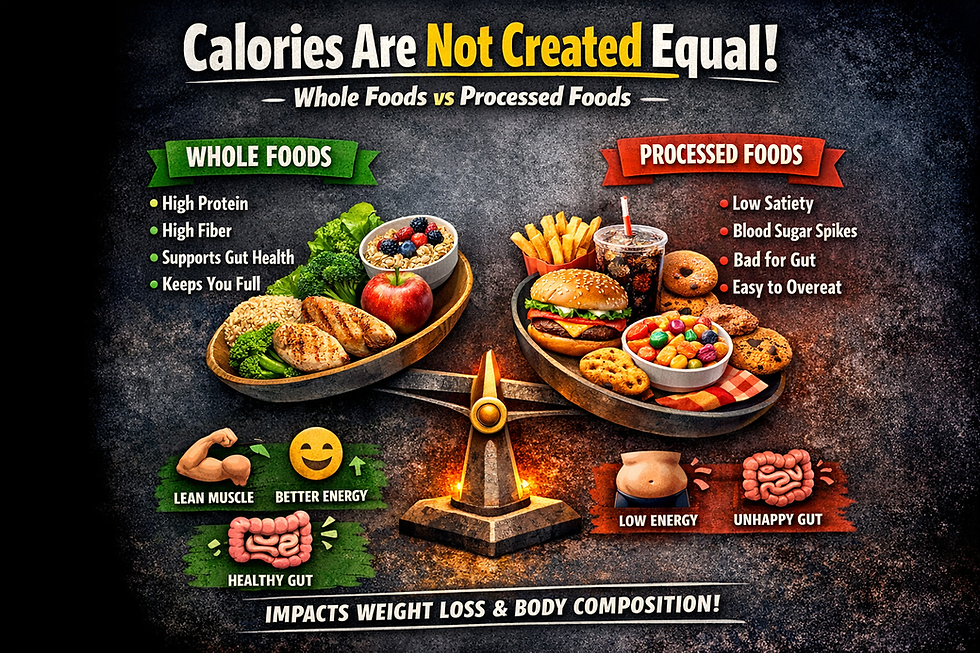
If you’ve ever heard someone say “weight loss is just calories in vs calories out,” they’re not wrong… but they’re massively oversimplifying it.
Because yes — a calorie is a unit of energy.
But your body is not a bomb calorimeter.
Your body is a living, adapting system with hormones, hunger signals, digestion speed, blood sugar responses, muscle retention mechanisms, stress responses, and even your gut microbiome that all influence:
✅ how many calories you actually absorb
✅ how full you feel after eating
✅ how easy it is to stick to your plan
✅ how much lean muscle you keep
✅ whether weight loss looks like fat loss… or just “smaller but softer”
So while calories matter, the type of calories you eat changes the outcome.
Let’s break it down.
1. Why Calories Aren’t “Equal” in the Body
Calories are energy, but when you eat different foods, your body handles them differently.
A calorie of protein is not the same as a calorie of fat or carbs
One of the biggest reasons is something called the Thermic Effect of Food (TEF) the calories you burn digesting and processing what you eat.
Protein costs the body the most energy to digest
Carbs are moderate
Fat costs the least
So two people could eat the same calories, but burn different amounts simply digesting their diet.
This is one reason higher protein diets are so effective for fat loss and body composition:
✅ more fullness
✅ better muscle retention
✅ higher TEF
Protein’s role in weight loss and maintenance has been strongly supported in research.
2. “A Carb Is a Carb” Is One of the Biggest Nutrition Myths
Carbs all contain 4 calories per gram — but that’s where the similarity ends.
Your body doesn’t respond the same way to:
oats vs sugary cereal
fruit vs fruit juice
potatoes vs crisps
lentils vs white bread
rice vs biscuits
Because carbs affect the body differently depending on:
✅ Fibre content
Whole-food carbs usually contain fibre, which:
slows digestion
increases fullness
improves blood sugar control
supports gut health (this is huge for the microbiome more on that below)
Higher fibre intake is consistently linked with improved appetite regulation and better weight management outcomes.
✅ Glycemic response
Some carbs spike blood sugar fast, causing a sharper rise in insulin and often a faster return of hunger.
Low glycemic index diets can improve weight loss outcomes and improve glucose/insulin control compared to higher GI approaches.
✅ Food form & processing
A “carb” in its whole form (like an apple) behaves very differently from the same carb in liquid or processed form (like apple juice).
Whole foods require chewing, digest slower, and tend to be naturally portion-controlled.
3. Why Ultra Processed Foods Make Fat Loss Harder (Even at the Same Calories)
Here’s where things get very real for everyday dieting.
Ultra processed foods don’t just make you eat more because they taste good…they often make you eat more because they’re designed to be:
easy to chew
quick to swallow
low in satiety per calorie
hyper-palatable
easy to over consume
The biggest proof? A controlled inpatient study
In a landmark NIH trial, participants were given either an ultra-processed diet or an unprocessed diet.
The meals were matched for presented calories, macronutrients, sugar, sodium and fibre, yet people ate more calories per day on the ultra processed diet and gained weight.
In plain English:
Even when the diet looked identical on paper, processed food led to automatic overeating.
That matters because fat loss success isn’t about perfect discipline it’s about building a plan you can consistently follow without feeling like you’re fighting hunger 24/7.
4. Weight Loss vs Body Composition: Why Food Quality Matters
Weight loss is simply “scale weight going down.”
Body composition is what you’re losing:
fat mass vs lean mass
muscle mass vs “flat and skinny”
strength and performance vs weaker and drained
The goal for most GFC Athlete clients isn’t just to weigh less.
It’s to look better, perform better and feel better.
Higher quality foods support better body composition because they:
✅ improve training performance (more output, more stimulus)
✅ support recovery (less soreness, better sleep, better energy)
✅ help retain lean muscle (especially with enough protein)
✅ control hunger (making adherence easier)
✅ reduce “snack creep” (mindless extra calories)
Protein intake is also associated with improved satiety and appetite control during dieting phases.
✅ 5. Why This Matters for the Gut Microbiome (and Your Results)
Your gut microbiome is the trillions of bacteria living in your digestive system.
They don’t just “sit there” they actively influence:
how hungry you feel
how well you digest food
inflammation levels in the body
how your body handles carbs and blood sugar
cravings and food choices
how easily you stick to your calorie target
even your mood and stress response
So when we say “calories aren’t created equal,” part of what we mean is:
Different foods feed different gut bacteria
Whole foods, especially plant foods, contain things your body can’t fully digest, like fibre and resistant starch.
These act like “food” for good gut bacteria.
When those bacteria break fibre down, they produce compounds (like short-chain fatty acids) that are associated with:
✅ better gut health
✅ improved appetite control
✅ lower inflammation
✅ better metabolic function
That’s a massive win if your goal is fat loss + better performance + better energy.
Why processed foods can mess with the gut
Ultra processed foods tend to be:
low in fibre
low in micronutrients
easy to overeat
higher in additives/emulsifiers/artificial ingredients (in many cases)
When most of your diet comes from ultra processed sources, you often lose the variety of fibre and nutrients that support a diverse and resilient microbiome.
That can lead to:
more cravings
worse digestion/bloating
feeling hungrier more often
less control around food
more inflammation and fatigue (especially alongside poor sleep + stress)
Even if calories are the same “on paper,” the biological outcome can be completely different.
Your gut microbiome can influence hunger + cravings
This is the part that explains their real life experience.
Some foods don’t just “fit macros”… they drive you to want more.
Whole foods generally lead to:
✅ longer fullness
✅ steadier energy
✅ fewer cravings
✅ better digestion
Processed foods often lead to:
❌ quick hunger rebound
❌ snack cravings later
❌ feeling like you’re constantly “starting again Monday”
This is why building a diet around whole foods isn’t about being “clean”…
It’s about making the plan sustainable without constant mental effort.
6. Why Whole Foods Are Better for Fat Loss (Without “Dieting Harder”)
Whole foods win because they help you achieve the calorie deficit without white-knuckling it.
Whole foods tend to be naturally:
higher volume (more food per calorie)
higher fibre(slower digestion + fullness)
higher protein density
more micronutrient rich
less likely to trigger overeating
better for gut health and digestion
So instead of relying on willpower, you rely on a system that works with your biology.
Example:
300 calories of whole food:
chicken + potatoes + veg. You feel full for hours.
300 calories of ultra processed food:
biscuits, crisps, cereal bars. You might feel hungrier 30 minutes later.
This is why people can “eat clean” and accidentally lose weight without tracking… and why people can “hit calories” while eating mostly processed foods and still feel constantly hungry.
7. The Real Reason “Calories Aren’t Equal” for Clients in the Real World
Even if you could perfectly measure calories (you can’t) and even if food labels were perfectly accurate (they aren’t), the biggest difference comes down to this:
Food quality changes behaviour
And behaviour changes results.
Because the best diet isn’t the “perfect” one.
It’s the one you can stick to long enough to get the outcome.
Whole foods make that easier by improving:
✅ fullness
✅ energy
✅ cravings
✅ digestion
✅ recovery
✅ consistency
And consistency is what changes your body.
The GFC Athlete Takeaway
If you want better weight loss and better body composition, focus on:
1) Calories (yes), but also…
2) Protein
3) Fibre
4) Whole foods 80–90% of the time
5) Carbs that support performance, not cravings
6) A plan you can sustain
7) Gut health as a performance tool (not just digestion)
You don’t need perfection. You need a structure where your diet works with you, not against you.
Studies & Research Links (for further reading)
Ultra-processed diets increase calorie intake and weight gain (NIH inpatient RCT) – Hall et al., 2019
Protein’s role in weight loss & maintenance (TEF, satiety, compliance) – Leidy et al., 2015
Higher-protein dieting improves appetite control during weight loss – Leidy et al., 2011
Low glycemic index diets and weight loss/glucose control – Juanola-Falgarona et al., 2014
Fructose and de novo lipogenesis (mechanisms relevant to metabolic health) – Geidl-Flueck & Gerber, 2023
Fructose vs glucose and metabolic effects (mechanistic paper) – Softic et al., 2017

