
Why the Scale Fluctuates Daily And Why You Must Look Beyond the Number
- Ginge

- Jan 11
- 5 min read
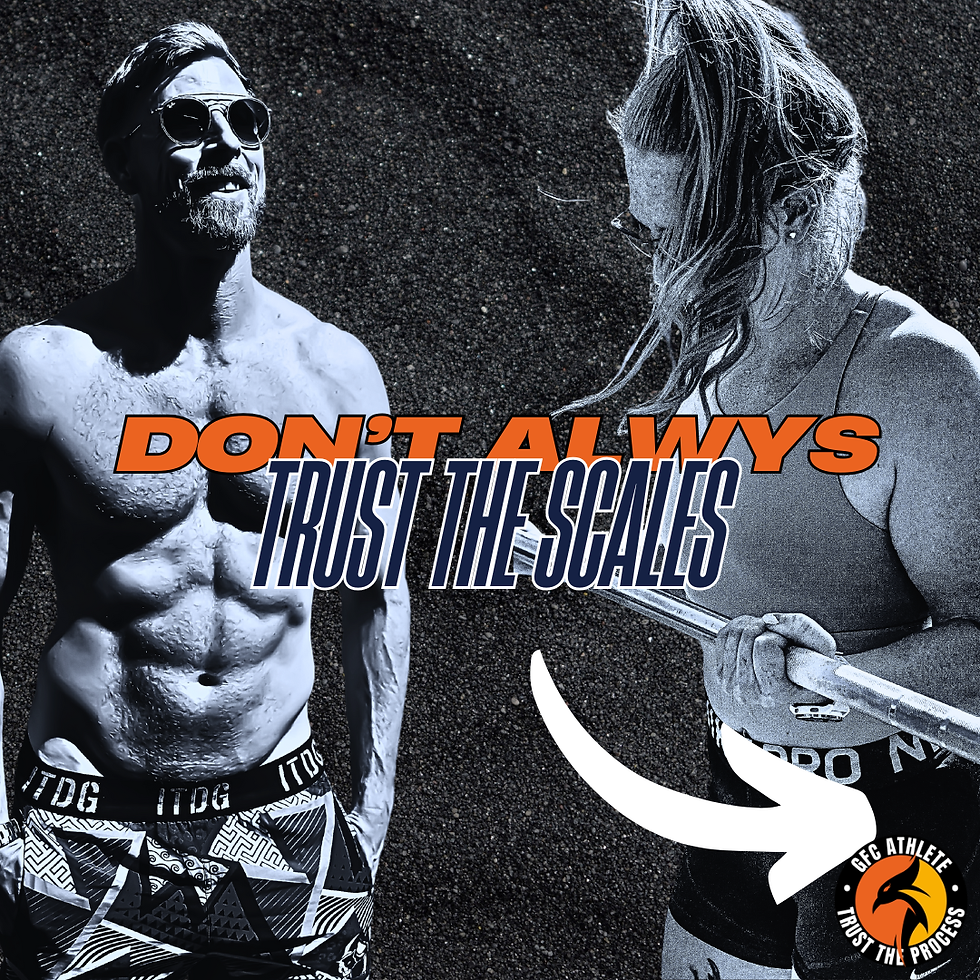
When you’re weighing in daily as part of your nutrition journey, we need to understand what the data actually means and who it's for!
Daily weigh ins are a data collection tool, not a judgement of success or failure. The problem isn’t the scale itself, it’s how much meaning people attach to a single day’s number without context.
Let’s go deeper into why the scale moves, why it’s not body fat and why your real progress is often showing up elsewhere first.
The Scale Measures Weight, Not Fat
The first thing to understand is that the scale only measures total body weight. That includes:
Body fat
Muscle
Water
Food sitting in your digestive system
Glycogen (stored carbohydrates)
Waste
Because so many variables influence that number, it’s impossible for the scale to tell you what you’ve gained or lost only that your total mass has changed.
To put this into perspective: To gain 1 lb (0.45 kg) of body fat, you’d need to consume roughly 3,500 calories above maintenance. For most people, that doesn’t happen accidentally overnight. So if the scale jumps up after a normal day of eating, it’s almost certainly not fat gain.
The Main Reasons Your Weight Fluctuates Daily
1. Water Retention
Water is the biggest driver of short term scale changes.
Eating more carbohydrates causes your body to store more glycogen and each gram of glycogen holds around 3–4 grams of water
High sodium meals can temporarily increase water retention
Dehydration one day can lead to rebound water retention the next
It’s completely normal for water weight alone to fluctuate by 1–3 kg.
2. Food Volume and Digestion
If you’ve eaten later than usual, had a larger meal, or increased fibre intake, that food still has mass.
Until it’s fully digested and excreted, it shows up on the scale even though it has nothing to do with body fat.
3. Hormones (Especially for Women)
Hormonal fluctuations can significantly affect water balance.
Menstrual cycles
Ovulation
Stress hormones like cortisol
Many women notice predictable scale increases at certain points of their cycle, even when nutrition and training are consistent.
4. Training and Muscle Inflammation
Hard training causes microscopic muscle damage (a good thing). During recovery, the body pulls fluid into the muscles to repair them.
That means:
Soreness = inflammation
Inflammation = temporary water weight
Ironically, the better your workouts, the more likely the scale might spike.
5. Sleep and Stress
Poor sleep and high stress elevate cortisol levels, which can increase water retention and disrupt digestion.
A stressful week can easily mask fat loss on the scale even when progress is happening underneath.
Why Daily Changes Are Not Fat Gain
Fat gain and fat loss happen slowly.
Fat loss is measured over weeks, not days
Fat gain requires a consistent calorie surplus over time
A 1 –2 kg jump overnight is almost always:
Water
Food weight
Inflammation
Not fat! If fat gain happened as fast as the scale suggests, people would gain kilos just from a takeaway and a bad night’s sleep and that’s simply not how the body works.
The Danger of Fixating on the Scale
When people weigh themselves daily without context, the scale can:
Create unnecessary stress
Lead to emotional decision making
Encourage extreme restriction after a “bad” weigh in
Mask real progress
Many people abandon good habits because the scale doesn’t move the way they expect even though they’re getting leaner, stronger and healthier.
This is how progress gets sabotaged.
What Actually Matters: The Trend Over Time
When weighing daily, the goal is not to chase the lowest number.
The goal is to observe:
Weekly averages
Downward trends across weeks
Consistency, not perfection
If fat loss is your goal and:
Your weekly average is trending down
Your habits are consistent
You feel better, stronger and more in control
Then you are progressing even if today’s number is up.
Daily spikes and drops are just noise. The trend is the signal.
Why Progress Photos Matter More Than the Scale
Fat loss is a visual change, not just a numerical one.
Progress photos:
Show changes in shape and definition
Highlight fat loss even when scale weight stalls
Reveal posture improvements and muscle tone
Provide objective proof when your mindset is doubting progress
Many clients look noticeably leaner in photos while the scale hasn’t moved or has even gone up slightly due to muscle gain or water retention.
📸 Photos don’t lie, emotions around the scale often do.
Strength Improvements = Body Recomposition
Getting stronger is one of the clearest signs your nutrition and training are working.
If you are:
Lifting heavier
Performing more reps
Feeling more stable and powerful
Recovering better between sessions
Your body is adapting positively.
This matters because:
Muscle tissue improves metabolic health
Muscle gives your physique shape and firmness
Fat loss often accelerates after strength improves
Sometimes the scale slows because your body is building muscle while losing fat a net change the scale struggles to reflect.
Mood, Energy & Focus: The Hidden Metrics
One of the biggest mistakes people make is ignoring internal progress.
Improved nutrition should lead to:
Better daily energy
More stable mood
Reduced cravings and food obsession
Better sleep quality
Improved focus and productivity
If these are improving, your plan is working even if the scale hasn’t caught up yet.
A plan that drops scale weight fast but leaves you exhausted, moody and burnt out is not success.
How Clothes Fit: One of the Best Indicators
Clothing fit is one of the most reliable fat loss indicators because:
Fat loss changes body volume
Muscle improves shape and firmness
Water fluctuations don’t affect fit as much as fat loss
If:
Waistbands feel looser
Jeans fit better
Tops sit differently
You feel more comfortable in your clothes
That is real progress regardless of what the scale says that morning.
How to Use Daily Weigh-Ins Properly
If you’re weighing daily, here’s how to do it correctly:
✔ Same time every day
✔ Same conditions (morning, after bathroom, before food)
✔ Record the number without emotion
✔ Look at weekly averages, not single days
And most importantly:👉 Never adjust your plan based on one weigh in
Final Takeaway: The Scale Is One Data Point — Not the Full Picture
Daily fluctuations are normal. Expected. Harmless.
As long as:
Your weight is trending downward over time (if fat loss is your goal)
Your habits are consistent
Strength, photos, clothes fit, mood and energy are improving
You are on the right path. Trust the process. Respect the data but don’t let one number override everything else your body is telling you.
Fat loss isn’t linear. Progress isn’t fragile and the scale is only one small piece of the puzzle!

